
Private-Label Coconut Water: What to Prepare Before Requesting Quotes
Planning a private-label coconut water? Prepare a clear product brief, verify supplier documentation and compare quotes without relying on generic MOQ or certification promises.
Private-label coconut water is a beverage manufactured by a contracted producer and sold under another business's brand. Before contacting a producer, the buyer needs to define what the drink should be, where it will be sold and what evidence will be required to support the label. This early preparation is often more useful than shopping for the lowest unit price.
This article provides a pre-quotation checklist for retailers and emerging beverage brands. It is an educational guide, not a claim that VINUT TRUST owns coconut-processing facilities or personally offers every listed manufacturing service. A separate guide to evaluating coconut water contract manufacturers covers a broader supplier review. Both articles should be checked for overlapping search intent before being published together.
1. Define the finished drink before choosing a supplier
Begin with the actual product, not a factory's marketing catalogue. A coconut-water beverage may be intended as straight coconut water, a fruit-flavoured blend, a drink with pulp or another prepared formulation. The name, ingredients and claims must match the final recipe and the market's rules.
For an initial brief, record the intended flavour, sweetness, ingredients, serving size, packaging format and retail market. If the concept is “100% coconut water”, ask what evidence supports that description. If a version contains added fruit ingredients or sweeteners, do not assume it belongs to the same legal product category.

Do not assume “sugar-free” means “no added sugar”. A product's intrinsic sugars and any added sugars are different questions. Nutritional and ingredient claims need supporting product data and relevant market checks, not an analogy to a coconut or a competitor's pack.
2. Make the packaging and intended shelf life explicit
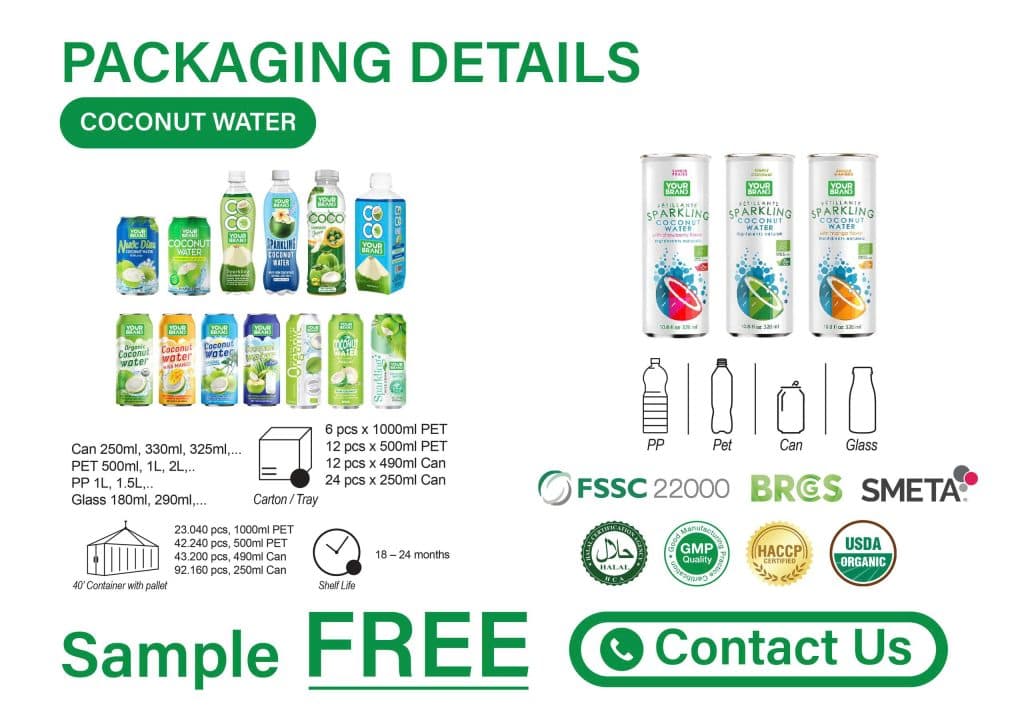
A quotation for an aluminium can is not automatically comparable to one for a PET bottle or carton. The selected pack influences the filling process, label space, transport protection and the product's storage instructions.
Decide whether you want a particular pack type, size, case count and pallet format. Treat these as requirements to confirm, not as proof a factory offers them. Ask what process and packaging combination the supplier proposes for the selected formulation.
Shelf life is especially important: request the validated target for the actual finished food, together with the storage conditions and relevant testing or supporting records. The existence of aseptic or high-temperature equipment by itself does not prove that every recipe will be shelf-stable for a particular number of months.
3. Request traceable sourcing and product evidence
Coconut-water characteristics can vary with raw material and processing. Before endorsing claims such as “from Bến Tre coconuts”, “organic”, or “single origin”, request evidence that supports the exact raw material and finished-product statements.

This original article image was labelled as a Bến Tre coconut garden. Its location and provenance have not been independently verified, so it should not be treated as proof of a supplier's sourcing.
Useful questions include: Where does the input come from? Is it extracted on site or received as a processed ingredient? What documents connect the lot to the stated source? How are changes in flavour, colour and other specified properties assessed? If the answers remain general, the final brand story should stay general too.
4. Check regulatory responsibilities for each destination market
A supplier's marketing brochure cannot substitute for legal requirements in the country of sale.
For United States imports, the FDA's Importing Human Foods overview describes applicable entry requirements, facility registration and food-safety programmes. FDA explicitly says it does not approve individual imported food products, labels or shipments in advance. Registration should therefore not be advertised as “FDA product approval”.
Some food importers must have a Foreign Supplier Verification Program (FSVP), subject to the rule's scope and exemptions. The FDA's FSVP rule overview explains risk-based supplier verification. The FDA's juice HACCP guide describes controls for covered juice products. Applicable obligations depend on product classification and business roles.
For European Union prepacked foods, the European Commission's mandatory food information guidance covers matters including product name, ingredients, allergens, net quantity, dates, storage, business operator details and nutrition declarations, subject to the applicable provisions. Check any product-specific and national requirements too.
These links identify areas to verify, not legal clearance for any particular private-label coconut water.
5. Compare proposals on the same assumptions
A credible comparison requires the same product specification from every candidate. Otherwise, a lower quote may simply describe a different formulation, pack or delivery responsibility.
Request from each candidate | Why it matters |
|---|---|
Formula and ingredient specification | Confirms what the quotation actually covers |
Sample plan and approval method | Prevents a pilot sample being mistaken for a finished commercial batch |
Process and food-safety evidence | Supports evaluation of the actual product and production site |
Packaging artwork requirements | Identifies label dimensions, printing costs and approval responsibilities |
MOQ, lead time and capacity assumptions | Shows the order size and timing to which the quote applies |
Shelf-life support and storage conditions | Prevents generic stability or “no preservatives” promises |
Price breakdown, Incoterm and exclusions | Separates manufacturing, packaging, logistics and additional charges |
There is no universal correct MOQ or launch timetable. A first order may depend on the formula, printing setup, packaging supply, testing, production slot and import destination. Ask the manufacturer to document its assumptions instead of relying on invented industry-standard numbers.
6. Use a short pre-quote brief
A buyer can send a concise brief containing eight elements: target country, proposed product name and composition, desired taste, pack format and size, expected order volume, required claims or certifications, desired launch window and contact for technical questions.
Then ask for a response separating: what the producer can currently demonstrate, what needs development or validation, what must be provided by the brand owner and which requirements remain subject to regulatory review.
Once two or more quotations arrive, compare them against the same brief and request product-specific documentation before making contractual commitments. A sample is an opportunity to test flavour and presentation, not proof of future sales or regulatory compliance.
7. Keep the brand and manufacturer roles clear
A contract producer, a brand owner, an importer and a distributor may have different responsibilities. The exact parties and their legal names matter when discussing plant certificates, product labels and commercial commitments.
This VINUT TRUST Journal article is general industry education. It does not claim that VINUT TRUST owns the factory, holds every certificate listed in the discussion or guarantees private-label coconut water production. For questions about the brand's current product offerings and the appropriate company contact, use VINUT TRUST's contact page and request verified information for the actual business and product.
The takeaway: A useful first step in private-label coconut water is a clear product and evidence brief. Define the drink, pack and market, then ask suppliers for comparable, documented proposals. Avoid assuming that a generic certificate, sample date or attractive image proves a specific product is ready for sale.
QUESTIONS & ANSWERS
Frequently asked questions
What should be in a private-label coconut water RFQ?
Include the target market, intended formulation and claims, packaging and serving size, forecast quantity, proposed launch window, regulatory documentation needs and questions for the supplier.
Is there a standard MOQ for private-label coconut water?
No single MOQ applies to all products or manufacturers. It depends on the formulation, packaging, production setup and commercial agreement. Request a quotation with explicit assumptions.
Does an FDA food facility registration mean coconut water is FDA-approved?
No. FDA states it does not approve individual imported foods or labels in advance. Facility registration and applicable food safety or importer obligations need separate consideration.
How can a buyer compare two coconut water manufacturers fairly?
Give both suppliers the same product brief and compare formulation, samples, documentation, pack specification, quality controls, shelf-life evidence, total cost and actual lead time.
Coconut Water with Pulp: Five Simple Ways to Enjoy Its Texture
Discover the soft coconut pieces in pulp-style coconut water, five serving ideas and a practical guide to ingredients, sugars and safe storage.
Read Story
Coconut Water OEM Factory: A Practical Evidence and Follow-Up Checklist
A buyer-focused checklist for coconut water OEM projects: verify the actual producer, request comparable records and quotes, and document what happens after a factory visit.
Read Story
How to Evaluate a Coconut Water Contract Manufacturer: An Evidence Checklist
Evaluate a coconut water co-packer using actual facility and product evidence, traceability, food safety controls, samples, commercial terms and documented risk-based decisions.
Read Story