
UAE Beverage Labeling: Arabic, Ingredients and Nutrition Claims
An importer-focused UAE beverage label checklist covering Arabic wording, ingredients, nutrition panels, claims and the separate Dubai food-item review process.
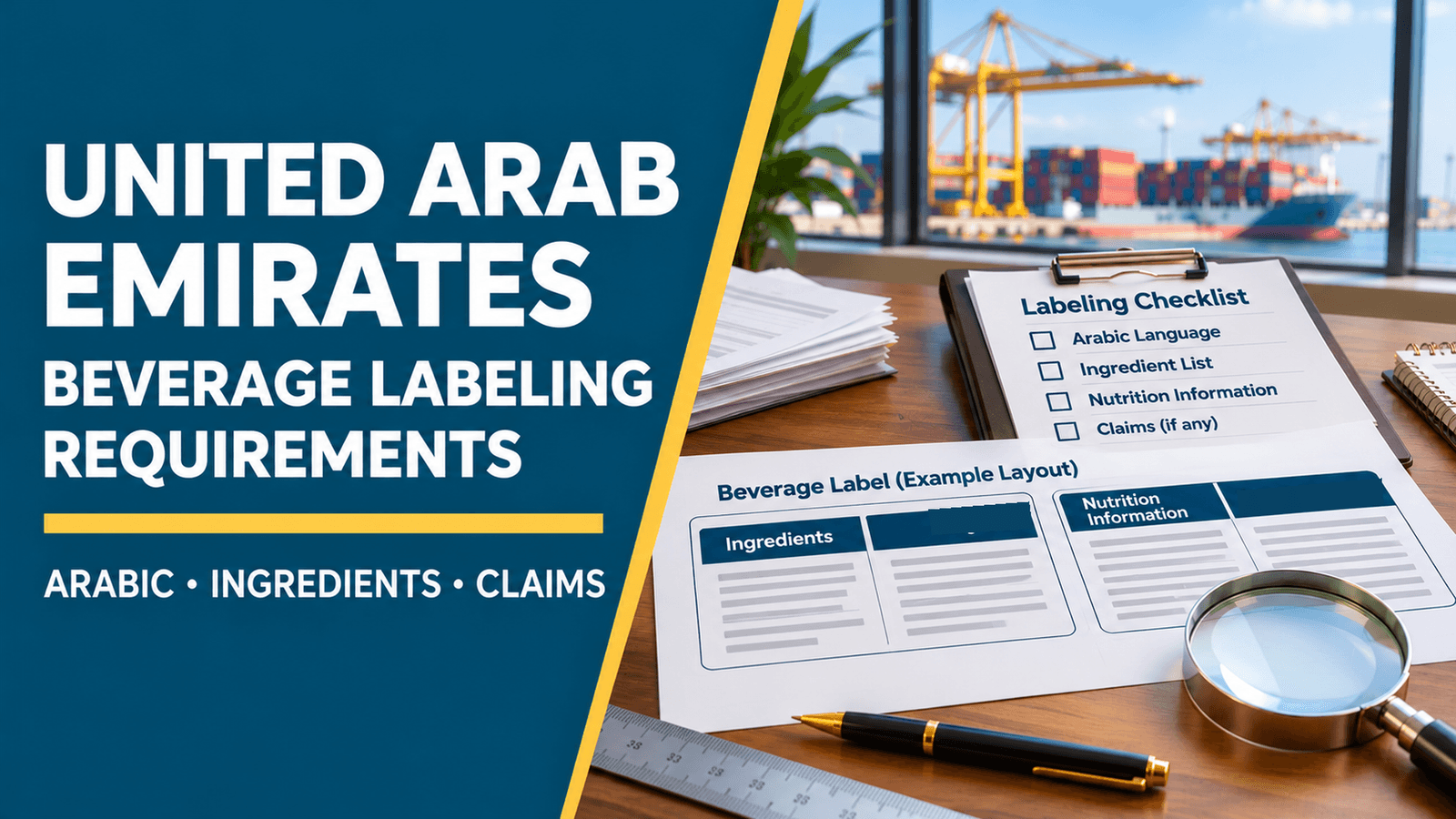
For packaged non-alcoholic drinks intended for UAE retail sale, the buyer and overseas supplier should check Arabic wording, ingredients, nutrition information and marketing claims before printing labels. Federal food-safety rules address misleading or missing information, but the exact applicable technical standards must be verified for each product. This guide assumes Vietnam as a possible, unconfirmed origin and covers commercial local sale, not transit or re-export.
Which UAE rules govern beverage labels?
Cabinet Resolution No. 26 of 2017, implementing the Food Safety Law, addresses inaccurate nutrition information, undisclosed ingredient changes and misleading labeling. Article 14 identifies discrepancies between actual contents and label information. Article 15 addresses missing required Arabic information and problematic claims. These are federal rules, not an approved artwork template. Federal executive regulation, Articles 14–15.
For juice and beverage products within the scheduled scope, Cabinet Resolution No. 30 of 2018 points to UAE.S GSO 9 and product-specific technical standards. Article 2 limits scope by the schedule, while Article 4 addresses explanatory label information and quantity. Do not assume every drink is regulated identically. Juice and beverage regulation, Articles 2–4.
Dubai Municipality offers Register and Assess a Food Item and Release of Imported Food Consignments for Local Market as separate services. Dubai's process cannot automatically be applied to every emirate. Dubai Municipality services.
Which label fields should the importer check?
Start with the final recipe and artwork, not a generic export label. Compare the product identity, ingredients, additives, pack volume, origin statement, nutrition, production and date information against the category's current adopted requirements. The federal executive regulation treats incorrect nutritional information and unreported ingredient changes as serious concerns. Article 14(2–3).
Review area | Supplier prepares | UAE importer verifies |
|---|---|---|
Product identity | Formula, ingredient and additive details | Category and applicable technical standard |
Arabic and English | Editable translation and label proof | Required Arabic content and equivalent meaning |
Nutrition | Validated data and calculations | Current format, measurements and exceptions |
Claims | Evidence for juice, sugar or function wording | Allowed claim and any separate review route |
Pack information | Origin, quantity, storage and dates | Applicable presentation before print |
This is an operational review aid, not a complete mandatory-label specification.
What does Arabic labeling require?
Article 15(4) of the 2017 federal regulation identifies labels missing information required in Arabic as misleading. It does not specify which exact wording or layout applies to each beverage under the latest adopted standard. Confirm the current Arabic-language technical text and the importer’s local interpretation before approving the artwork. Article 15(4).
Translate from the confirmed formula, not from a marketing name. Check that ingredients, potential allergens where relevant, storage directions and product identity retain their intended meaning. Re-review the label whenever flavor, formula, packaging or claims change.
How should nutrition and claims be reviewed?
The 2017 regulation addresses cases where nutrition data do not match the actual food and where nutrition or health claims conflict with requirements. Article 15 also addresses misleading or illegible text. The applicable claim conditions and any approval process depend on the specific beverage and its proposed wording. Articles 14–15.
Do not treat “no added sugar”, “100% juice”, “low calorie”, “energy” or “prebiotic” as approved categories merely because the supplier proposes them. Ask for the formula, supporting measurements and exact claim artwork. An EU or US label may help comparison but is not a UAE compliance decision.
What must happen before print approval?
The importer should identify the emirate of entry and retail sale, confirm current UAE standard editions and amendments, classify the particular drink, and document a qualified local label review. Where Dubai applies, the Municipality’s food-item service provides a route for assessing a food item and label, but this is not consignment release. Dubai Municipality services.
Stop artwork release if Arabic wording, nutrition format, claims or category scope remain unresolved. Keep the controlled label PDF, supplier specifications, nutrition support and buyer feedback together.
Discuss sourcing with VINUT TRUST: provide the destination emirate, beverage category and formula, proposed packaging and target volume for an OEM/Private Label discussion. The responsible importer and qualified reviewer retain regulatory decisions.
QUESTIONS & ANSWERS
Frequently asked questions
Can Dubai food-item registration replace requirements in another emirate?
Do not assume that it can. The importer must confirm the competent authority and intended distribution route.
Can an approved label be reused for a new flavor?
Recheck the exact formula, ingredient list, nutrition data and claims for the proposed variant before reusing artwork.
Is an EU or US nutrition panel sufficient for the UAE?
It is supporting data only. The importer must confirm UAE-specific rules and any product-category exceptions.
Does item registration mean a shipment is customs-released?
No. Dubai Municipality lists food-item assessment and imported-consignment release as distinct services.
Ghana Beverage Labeling: Language, Nutrition and Claims
An importer-led Ghana beverage label checklist covering English text, product identity, dates, nutrition evidence, claims and artwork review before print.
Read Story
Saudi Arabia Beverage Labeling: Arabic and Nutrition Checklist
A Saudi importer’s practical label-artwork checklist for packaged non-alcoholic drinks, covering Arabic text, nutrition information, claims and the checks needed before printing.
Read Story
Importing Packaged Beverages into Dubai for UAE Retail: Buyer Checklist
An importer-focused checklist for packaged drinks entering Dubai's retail market: food-item and label assessment, Customs declaration, food consignment release, and UAE excise checks.
Read Story