
Saudi Arabia Beverage Labeling: Arabic and Nutrition Checklist
A Saudi importer’s practical label-artwork checklist for packaged non-alcoholic drinks, covering Arabic text, nutrition information, claims and the checks needed before printing.
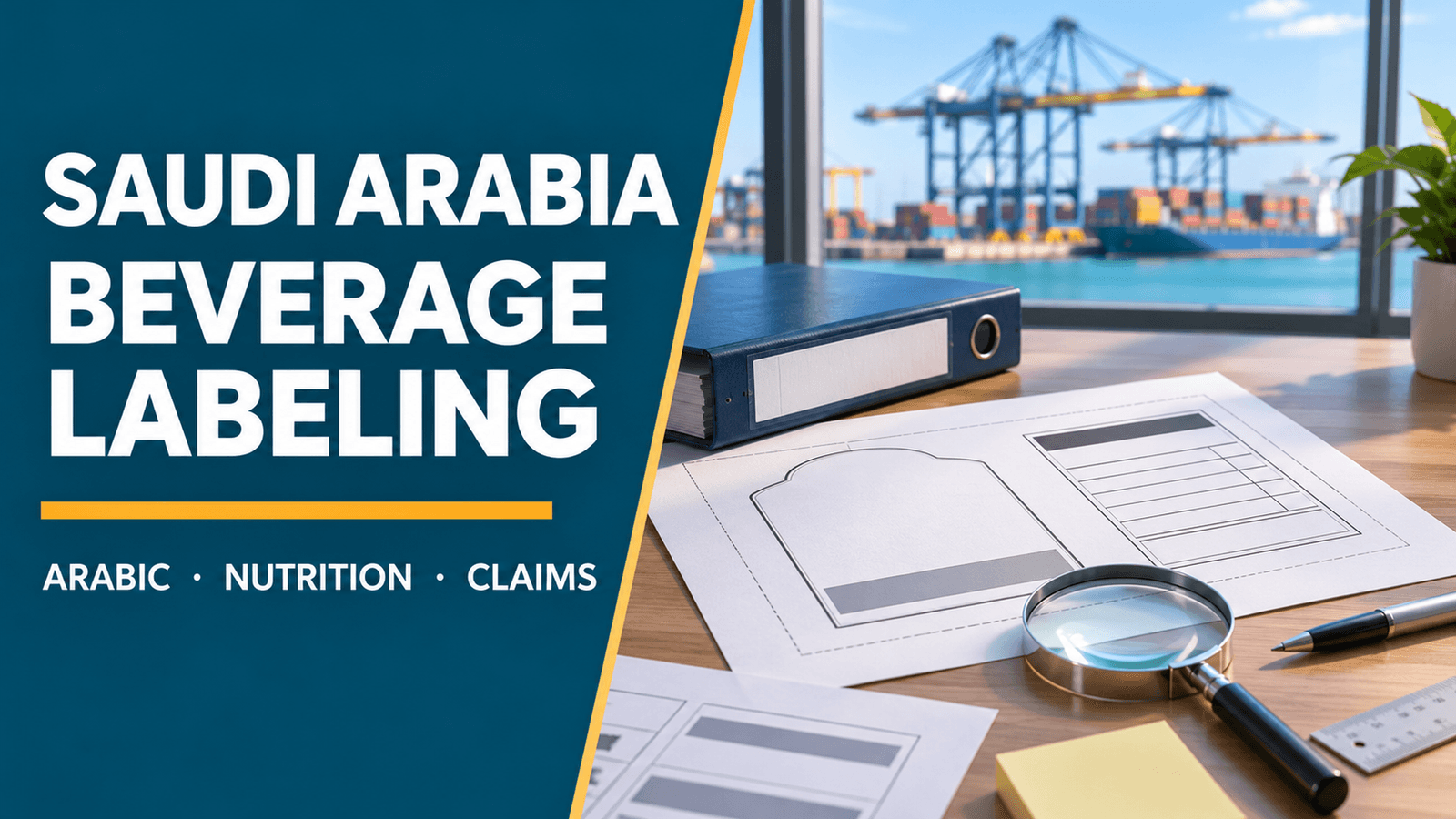
For packaged non-alcoholic beverages intended for retail sale in Saudi Arabia, the importer and overseas supplier should check Arabic labeling, nutrition information, product description and claims before approving artwork. The Saudi Food and Drug Authority (SFDA) identifies separate technical rules for these topics. This guide concerns commercial local sale, not transit or samples; Vietnam is only an assumed origin, and no specific SKU has been assessed.
1. Which Saudi labeling rules should the buyer examine?
SFDA directs food businesses to three instruments: SFDA.FD/GSO 9 for prepackaged-food labeling, SFDA.FD/GSO 2233 for nutritional labeling, and SFDA.FD 2333 for health and nutrition claims. See the agency's food-labeling FAQ. These are distinct subjects, not a single approval that applies automatically to every beverage.
This is a label and claim review for finished retail drinks. Juice drinks, coconut water, plant-based beverages, RTD coffee and energy drinks may need different category checks. Product composition, any animal-derived ingredients, caffeine, formulation, packaging, storage and intended claims are not yet verified. The importer must select the applicable category and obtain the current official text before treating this checklist as a final regulatory specification.
2. Is Arabic required on beverage packaging?
An English-only retail label should not be the approved print version. SFDA's Arabic-language FAQ explains that SFDA.FD/GSO 9 requires Arabic labeling and that information in another language must match the Arabic information. It does not say that simply adding an Arabic sticker solves every label issue.
For a bilingual draft, match the food name, ingredients, figures, warnings, storage directions and claims line by line. Have a competent Arabic reviewer compare the translation against the actual finished formula and source artwork. Confirm how any supplementary label can be applied with the Saudi importer before printing or shipping. Translation quality is a practical control; it is not proof of SFDA acceptance.
3. What belongs in the nutrition and date review?
SFDA identifies SFDA.FD/GSO 2233 as the nutritional-labeling instrument. Its shelf-life FAQ separately lists SFDA.FD 150-1 and SFDA.FD/GSO 150-2 for mandatory versus voluntary expiration-date categories. The exact declarations, units, date presentation and any exemptions must be checked in the current texts for the product category.
Before approving a nutrition panel, compare the final recipe, laboratory or calculated values, serving basis, sugar content and unit conversions with the source data. Check that the pack-size declaration, shelf-life evidence and printed date format agree with the proposed commercial SKU. Do not invent a standard sugar threshold, mandatory nutrient list, percentage daily value or expiry format from a generic example.
4. Which claims need extra evidence?
SFDA identifies SFDA.FD 2333 for nutrition and health claims. The agency's 2020 notice on claims not covered by national standards describes a separate assessment route and scientific-evidence review for claims outside the listed framework. This is an agency announcement, not proof that a proposed claim is currently permitted.
A phrase such as “no added sugar,” “high vitamin C,” “immune support” or “prebiotic” may require different assessment depending on formula and wording. A nutrient figure in the nutrition panel is not automatically permission to advertise a benefit. The importer should identify every express or implied claim, request evidence, and determine whether a current provision authorizes it or an additional decision is required. Do not use a claim on print-ready artwork merely because it appears on a label approved in another country.
5. How should supplier and importer approve the artwork?
Use this pre-print decision table with the Saudi importer. Items are buyer review actions, not a claim that this table reproduces every legally mandatory field.
Review item | Supplier prepares | Saudi importer confirms |
|---|---|---|
Product identity | Final category, formula, ingredient specification and label name | Appropriate SFDA category and product description |
Arabic and bilingual copy | Editable artwork and matching translation | Language, terminology and local artwork acceptance |
Nutrition and shelf life | Substantiated panel, pack size, storage and dating evidence | Current technical text and category exemptions |
Claims and visuals | Complete claims inventory with support | Applicable rules and any further SFDA assessment |
Final approval | Signed version control, revisions and print proof | Written go/no-go before printing and shipment |
Stop point: do not release mass-production artwork while the current editions or amendments to SFDA.FD/GSO 9, SFDA.FD/GSO 2233 or SFDA.FD 2333, category-specific provisions, and the exact SKU label remain unconfirmed. Registration and customs clearance are separate tasks and are not established by this checklist.
For an OEM/private-label beverage sourcing discussion with VINUT TRUST, share your destination, intended formula/category, packaging format and approximate order volume. The local importer should confirm the Saudi artwork requirements before any commercial printing commitment.
QUESTIONS & ANSWERS
Frequently asked questions
Does one Arabic translation work for every flavour?
Not necessarily. Each flavour may have different ingredients, nutrition values or claims. Review the actual formula and its corresponding bilingual artwork instead of reusing a generic translation.
Can a supplier use the nutrition panel approved for another export market?
It can be a working input, not the final Saudi panel. Compare its measurements, units, product category and format against the current Saudi requirements before artwork sign-off.
Does an SFDA food-product registration automatically approve a health claim?
No such conclusion follows from the registration alone. Check the claim against SFDA.FD 2333 and the authority's separate assessment route where the claim is not covered by existing standards.
Who should sign off the final bilingual label before printing?
The supplier should control final formula and artwork versions. The Saudi importer should obtain qualified local regulatory review and communicate a documented print-release decision.
UAE Beverage Labeling: Arabic, Ingredients and Nutrition Claims
An importer-focused UAE beverage label checklist covering Arabic wording, ingredients, nutrition panels, claims and the separate Dubai food-item review process.
Read Story
Ghana Beverage Labeling: Language, Nutrition and Claims
An importer-led Ghana beverage label checklist covering English text, product identity, dates, nutrition evidence, claims and artwork review before print.
Read Story
Importing Non-Alcoholic Beverages into Saudi Arabia: SFDA Checklist
A buyer-focused guide to Saudi SFDA food registration, Arabic labels, shipment documents and Fasah customs checks before importing packaged beverages.
Read Story