Cans, PET, Glass and Cartons: Beverage Packaging Compared
Compare beverage cans, PET bottles, glass bottles and cartons for protection, convenience, label checks and local recycling. No one material wins in every situation.
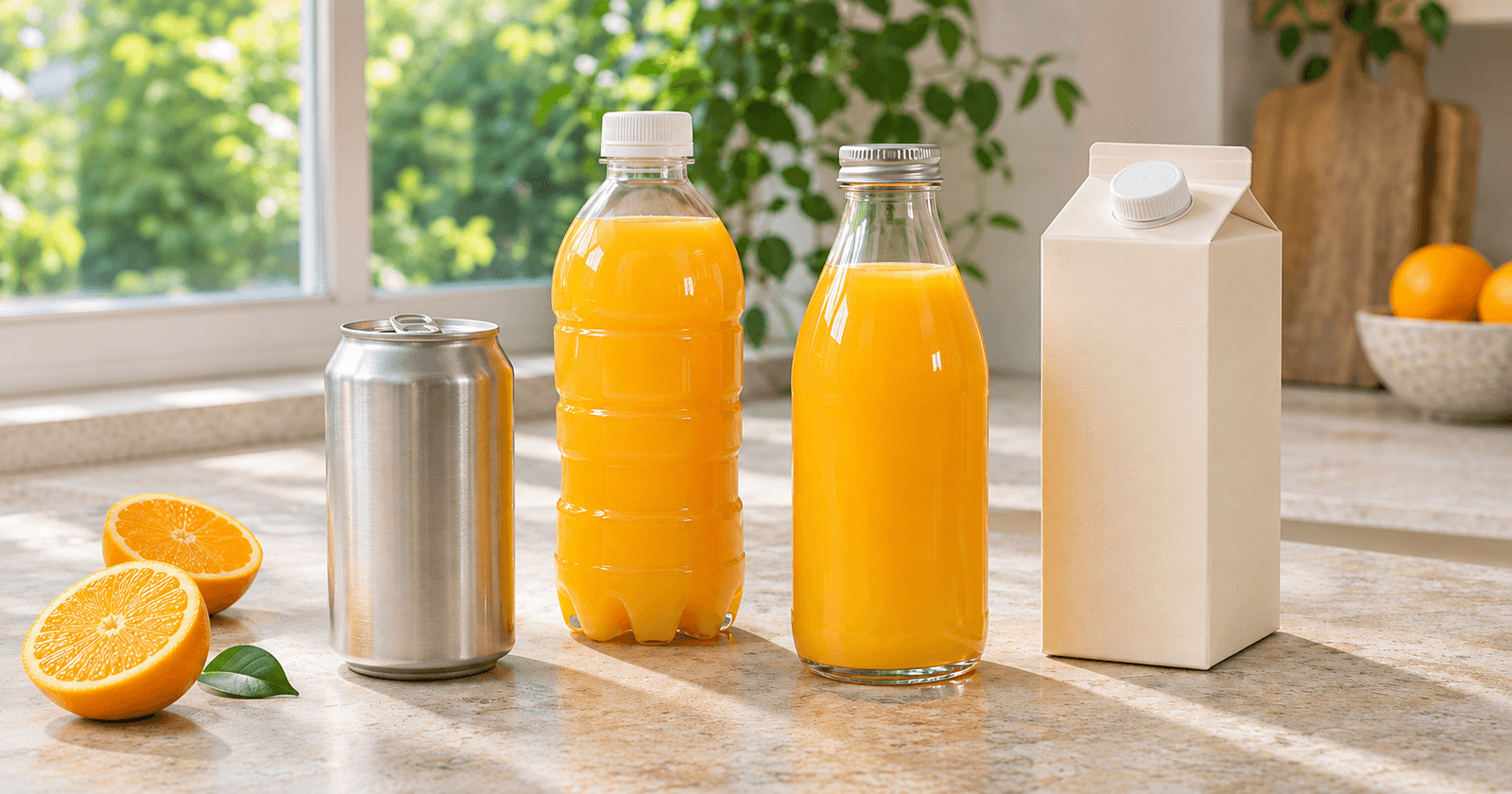
A can, a PET bottle, a glass bottle and a beverage carton can all contain a ready-to-drink beverage, yet they are not interchangeable. They differ in how they protect the contents, how convenient they are to use and what happens after the package is empty.
Quick answer: Cans are usually opaque and offer strong protection against light. PET bottles are generally light and can be resealable, but protection against oxygen and light depends on the bottle design. Glass is a strong barrier to gases, while colour and closure affect protection. Beverage cartons combine layers for different functions, especially in aseptic formats. No single package is automatically the safest, most recyclable or most sustainable for every drink.
1. What do these four packaging formats mean?
The closure, liner, seal, processing method and contents work together as a system. The FAO's guide to food packaging identifies food compatibility, protection from moisture, gases and light, strength, opening and resealing as selection factors.
1.1. Cans: opaque, compact and usually not resealable
Beverage cans are commonly made from aluminium, although material choices can vary. An intact metal body blocks light and is a strong barrier to gases and moisture. The end seam and any inner coating are important parts of the complete package.
Once opened, however, an ordinary pull-tab can cannot be resealed. Cans can also dent, and a damaged seam or a bulging container should not be ignored.
Do not assume the word can proves a particular processing method, shelf life or nutritional quality. Those facts depend on the finished product and its validated packaging process.

1.2. PET bottles: light, visible and often resealable
PET stands for polyethylene terephthalate, a plastic widely used to make beverage bottles. A clear PET bottle lets shoppers see colour or pulp, and a screw cap can make repeated pouring convenient. PET is not automatically an absolute oxygen or light barrier. Certain formulations need additional protection, which may involve colour, a sleeve, a coating or a specialised bottle design. The European Commission's discussion of PET barrier technologies explains why oxygen- and light-sensitive beverages may need enhanced packaging.
A resin identification number such as 1 identifies the plastic, not a promise that every local recycling programme accepts the bottle. Caps, labels, sleeves and sorting systems also matter.

1.3. Glass bottles: a strong material barrier with breakage trade-offs
Glass is chemically stable with many foods and acts as a barrier to gases and vapours. A transparent bottle displays the beverage, while coloured glass can reduce some light exposure. The cap and seal still determine whether the complete container remains properly closed.
The FAO describes glass as relatively heavy and susceptible to breakage, thermal shock and impact if not suitably designed or handled. A clear glass bottle also should not be treated as automatically protective against light.
Glass can be suitable for refill or return systems when those systems actually exist and meet applicable hygiene requirements. ### Beverage cartons: different layers doing different jobs

A beverage carton is not just folded paper. Cartons intended for chilled products and aseptic shelf-stable products can have different structures. Paperboard provides stiffness, polymer layers help with liquid containment and moisture protection, and many aseptic cartons use a thin aluminium barrier against oxygen and light.
Tetra Pak's explanation of aseptic packaging describes these functions. Not every carton has the same layers, cap or recycling pathway.
Importantly, aseptic refers to a particular processing-and-packaging system. A paper-based carton by itself does not make an unprocessed drink shelf-stable. After opening, follow the instructions on the actual package.
2. Cans vs PET vs glass vs cartons: the quick comparison
Format | Common practical advantage | What to check | End-of-life question |
|---|---|---|---|
Metal can | Opaque and convenient for single servings | Seams, dents, coating suitability and opening format | Does the local programme collect beverage cans? |
PET bottle | Light, often transparent and resealable | Light/oxygen needs, cap integrity and storage label | Is this bottle design accepted locally? |
Glass bottle | Strong material barrier and visible presentation | Closure, colour, weight and breakage risk | Is there collection, recycling or verified return? |
Beverage carton | Layered protection with lightweight handling | Aseptic or chilled design, closure and storage | Are beverage cartons collected and processed locally? |
This is a qualitative comparison, not a laboratory ranking. Real products differ by material grade, package construction, fill process, size and market. No carbon-footprint or shelf-life numbers are assumed.
3. Which package protects a beverage best from light and oxygen?
It depends on what the beverage needs. An intact metal can is opaque, while a clear glass or PET bottle exposes its contents to more light unless the design includes appropriate protection. Coloured glass and specialised PET designs can change this comparison. An aseptic carton may use a barrier layer specifically to limit oxygen and light exposure.
Oxygen is not the only concern. The integrity of a cap, seam or seal, the beverage's acidity, processing conditions and storage environment all affect the final result. Glass itself may be impermeable, but a poorly closed bottle is not a reliable protective system.
That is why it would be misleading to announce that one material guarantees a fixed number of months of freshness. Shelf life belongs to the validated drink-and-package combination, not to a material category on its own.
4. What about food safety and labels?
Packaging that comes into contact with a beverage must be suitable for that use. The US FDA's consumer explanation of food-contact substances includes packaging, adhesives and coatings and explains how intended use and potential migration are assessed in the US.
Requirements differ across markets. A product marketed in one country should not automatically be assumed compliant in another. For consumers, the practical step is to read the exact product label for storage, handling, allergens and date marking, rather than inferring food safety from whether a container is metal, plastic, glass or paper-based.
Do not drink from a visibly compromised package. Follow the manufacturer's directions for refrigeration or consumption after opening, regardless of the container type.

5. Is one of these formats more sustainable?
There is no responsible universal winner without a defined comparison. Weight, manufacturing, recycled content, transport distance, refill rates, collection, sorting and actual recycling outcomes can all influence environmental impact. Protection against food loss can matter too.
The US EPA's recycling guidance notes that materials accepted by local programmes vary. A plastic resin code does not guarantee collection, and glass collection also differs by location. A carton made of multiple materials may need specific processing infrastructure.
For the European market, the European Commission's packaging-waste overview describes rules covering packaging design, waste prevention, reuse and collection. Market rules and infrastructure are part of the decision, not proof that one format is always environmentally superior.
A useful sustainability claim should specify the exact package, geography, measurement method and evidence. “Recyclable everywhere,” “zero impact” and “the greenest drink package” are not suitable descriptions without substantiation.
6. A five-question checklist before choosing a beverage package
- What is in the drink? Light-sensitive juice, carbonated drinks and other formulations can have different packaging needs.
- How will I use it? Do I need a single serving, a resealable cap or an easy-to-pour container?
- What does the label say? Confirm storage conditions, the date mark and directions after opening.
- How will it travel? Consider weight, fragility and handling rather than appearance alone.
- What happens locally after use? Check whether the exact package belongs in a collection or return programme.
If you are exploring beverage formats for professional buying, VINUT TRUST's fruit juice product selection guide discusses why the chosen processing and package need to be verified together. For more everyday beverage reading, visit the VINUT TRUST Journal.
7. The takeaway
Cans, PET, glass and cartons each have useful properties and limitations. Select by the beverage, the way it will be used and the local recovery system, not by a single environmental slogan or the assumption that the package alone determines safety and freshness.
Sources and further reading
QUESTIONS & ANSWERS
Frequently asked questions
Which beverage packaging is best: can, PET, glass or carton?
There is no universal best option. Compare the finished drink's needs, barrier and closure design, storage instructions, convenience and local collection system.
Does a beverage carton contain only paper?
No. Beverage cartons commonly combine paperboard with polymers and, in many aseptic designs, an additional oxygen-and-light barrier. Structures vary by package type.
Does a PET recycling code guarantee that the bottle can be recycled locally?
No. A resin code identifies plastic type. Recycling depends on the actual bottle and local collection and processing rules.
Are glass bottles always more sustainable than PET or cans?
Not necessarily. A credible environmental comparison needs the specific container, transport, reuse or recycling arrangements and a consistent life-cycle method.