What Makes a Beverage Range Retail-Ready in America
Learn what makes a retail-ready beverage range in the U.S., from assortment and packaging to compliance, shelf life, pricing, and supply reliability.
By Vinut Trust
Quick answer
A beverage range is considered retail-ready when it can function effectively within the U.S. retail system, going beyond just being a finished product. This readiness encompasses a clear SKU assortment, channel-appropriate packaging, U.S. labeling compliance, a realistic shelf life, viable commercial economics, and a reliable supply chain.
On this page
A retail-ready beverage range is one that can move beyond simply being a finished product and work within a real U.S. retail system. Buyers need to understand the role of each SKU, target consumer, channel fit, packaging, labeling, shelf life, commercial economics, documentation, and supply reliability. Retail readiness is broader than product readiness and should be evaluated according to the specific channel and retailer.
1. What Does a Retail-Ready Beverage Range Look Like?
A beverage can have good taste, attractive packaging, production capacity, and a catalogue, yet still not be retail-ready.
1.1. Product-Ready vs. Retail-Ready
Product-ready means the product exists and can be presented. Retail-ready means the broader range can work within a retail system, including:
Clear SKU and assortment logic
Channel-appropriate packaging
U.S. labeling and compliance readiness
Realistic shelf life
Case and logistics requirements
Commercial viability
Reliable supply and replenishment
Consistent buyer information
The key question is not simply, “Is the product ready to sell?” but “Is the entire range ready for a buyer, distributor, and retail system?”
1.2. Retail Readiness for Beverage Private Label USA Programs
This also applies to a beverage private label USA program, where buyers will want to understand who is responsible for the label, compliance documentation, MOQ, and ongoing replenishment.
2. Start Your US Beverage Market Entry With the Target Retail Channel
There is no single definition of a beverage being “retail-ready for America.” For US beverage market entry, different channels can have different consumer, packaging, pricing, space, and logistics considerations.
2.1. Consider the Retail Environment
Relevant channels may include mainstream grocery, convenience, specialty grocery, natural retail, ethnic/multicultural retail, club, and e-commerce. For example, convenience stores may require a more focused approach to beverage assortment and pack formats.
Before presenting a range, consider:
Who is the target consumer?
What consumption occasion does the product serve?
Is the pack format appropriate?
Does the price position fit?
How much shelf or storage space is available?
Retail readiness is channel-specific.
3. Build a Clear SKU Architecture
A retail-ready range should not simply be a long list of flavors. Each SKU should have a clear role.
3.1. Define Hero, Core, Supporting, and Discovery SKUs
Hero SKU: Represents the range and gives buyers a clear entry point.
Core SKUs: Build the main assortment.
Supporting SKUs: Expand consumer choice.
Discovery SKUs: Add distinctive flavors or concepts.
The central question is:
Why does each SKU need to exist?
More SKUs can increase inventory, MOQ complexity, warehouse requirements, forecasting difficulty, and shelf fragmentation. There is no universal ideal SKU count; the right assortment depends on category, retailer, channel, and available space.
4. Meet Beverage Packaging Requirements and Product Information Needs
Packaging needs to work beyond the design file.
4.1. Match Pack Size to the Channel
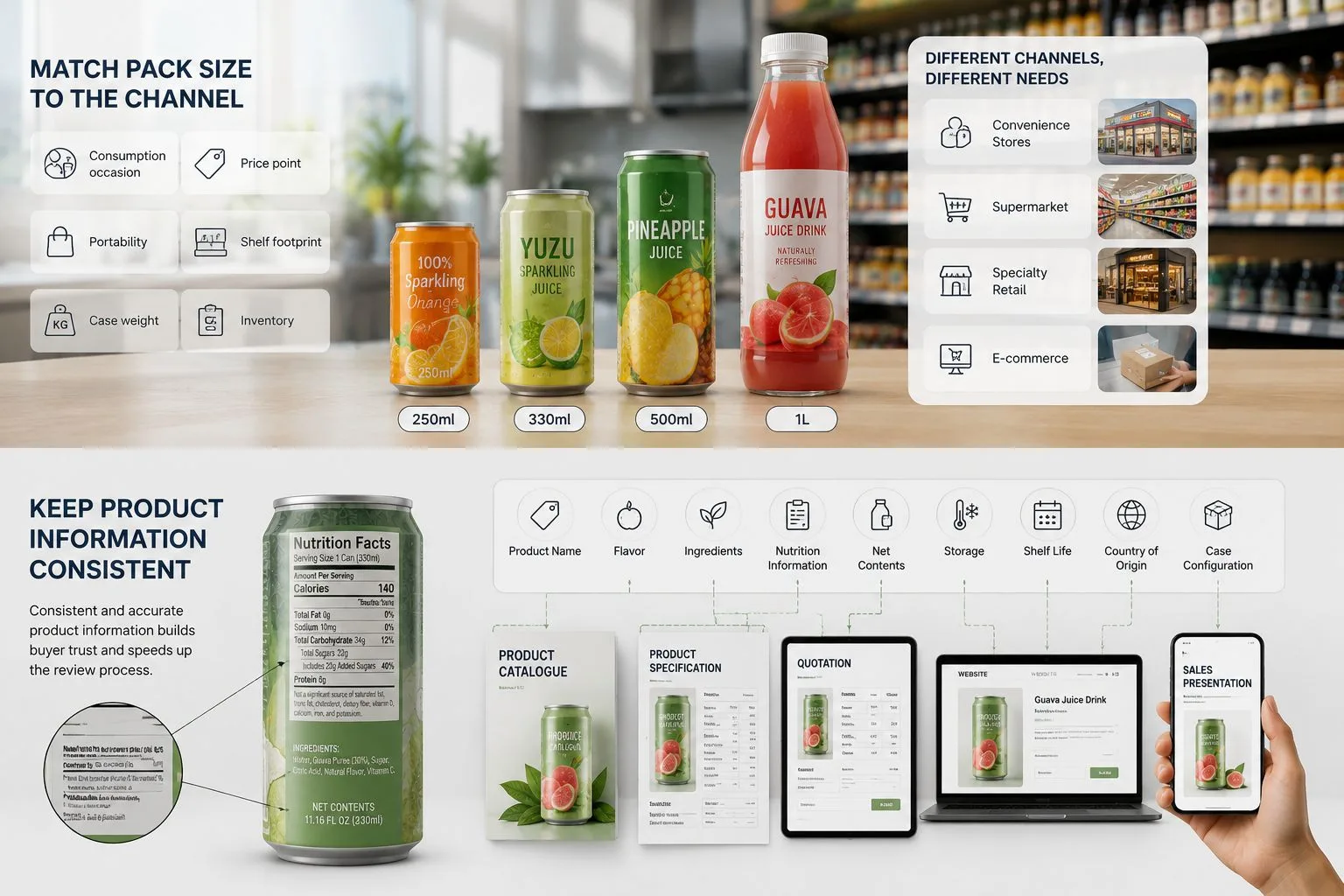
Beverage packaging requirements vary by channel, retailer, and consumption occasion. Pack size can affect consumption occasion, price point, portability, shelf footprint, case weight, and inventory.
Pack size can affect consumption occasion, price point, portability, shelf footprint, case weight, and inventory. It should be selected according to consumer and channel needs rather than simply based on an existing production format. For export-oriented beverages, choosing a specific can size also requires consideration of the intended market and logistics requirements.
4.2. Keep Product Information Consistent
Buyers may need product name, flavor, ingredients, nutrition information, net contents, storage, shelf life, country of origin where applicable, and case configuration.
This information should remain consistent across the label, catalogue, specification, quotation, website, and sales presentation.
5. Review Compliance and Shelf Life
Retail readiness also requires information that can be reviewed before a product enters the U.S. retail system.
5.1. Check U.S. Labeling Readiness
At a strategic level, buyers may review the statement of identity, ingredient list, nutrition information, allergen information, net quantity, company information, applicable country-of-origin information, and product claims. For detailed rules, suppliers can refer to the FDA Food Labeling Guide.
Certification requirements can vary by product and account. Where certifications are provided, buyers should review the certificate holder, scope, validity, facility, and certification body rather than assuming one certification applies universally.
5.2. Evaluate Shelf Life Across the Supply Chain
Shelf life should be considered from production through export, transit, customs, importer and distributor inventory, retail warehouses, and store shelves.
A long stated shelf life does not automatically mean the beverage is commercially retail-ready.
6. Make the Economics and Supply Chain Work
Retail readiness extends beyond the supplier's unit price.
6.1. Review Pricing, MOQ and Beverage Distributor Requirements
The commercial chain may include supplier price, freight, duty, customs, importer, distributor, retailer, and promotions. The key question is whether the SKU can reach a shelf price that makes sense for its category and positioning.
MOQ also affects inventory exposure and launch risk, while case dimensions, pallet data, lead times, and replenishment planning affect operational feasibility.
Beverage distributor requirements may also include case dimensions, pallet data, lead times, and minimum order quantities, so suppliers should prepare this information before approaching a distributor.
6.2. Plan for Replenishment
Retail readiness does not end with the first shipment. A supplier should be able to support repeat production, forecasting, replenishment, and stock continuity.
7. Use a Practical Retail Readiness Framework
Before presenting an imported beverage range USA opportunity, evaluate these 10 areas:
Market fit
Channel fit
SKU architecture
Packaging fit
Compliance readiness
Quality readiness
Supply-chain readiness
Commercial viability
Information readiness
Sell-through support
This is a decision-support framework, not an official U.S. retail standard. A range may be generally retail-ready while still requiring adaptation for a specific retailer.
8. Key Takeaway
A retail-ready beverage range is more than a collection of finished products. It needs clear SKU roles, channel-appropriate packaging, review-ready information, realistic shelf life, workable economics, reliable supply, and relevant buyer support.
The goal is not to create the largest possible range, but to create an assortment that a buyer can understand, evaluate, and potentially operate within the intended retail channel.
QUESTIONS & ANSWERS
Frequently asked questions
01What is the difference between a product-ready and a retail-ready beverage?
A product-ready beverage simply exists and can be presented. A retail-ready beverage range is prepared to work within a complete retail system, considering logistics, compliance, SKU assortment, and supply chain reliability.
02Why is the target retail channel important for a beverage's success?
The target retail channel is crucial because different channels, like grocery or convenience stores, have unique requirements for packaging, pricing, and logistics. A beverage's strategy must be tailored to its specific channel to be successful.
03What is a SKU architecture in a beverage range?
A SKU architecture defines the specific role of each product, such as Hero, Core, Supporting, and Discovery SKUs. This provides a clear logic for buyers and helps manage inventory, forecasting, and shelf space effectively.
KEEP EXPLORING
Related stories
Continue exploring this topic in the VINUT TRUST Journal.