
NAFDAC Registration of Imported Drinks: Applicant and Dossier Guide
A practical NAFDAC registration checklist for Nigerian importers of packaged drinks, covering local applicant authority, dossier evidence, label assessment and approval stages.
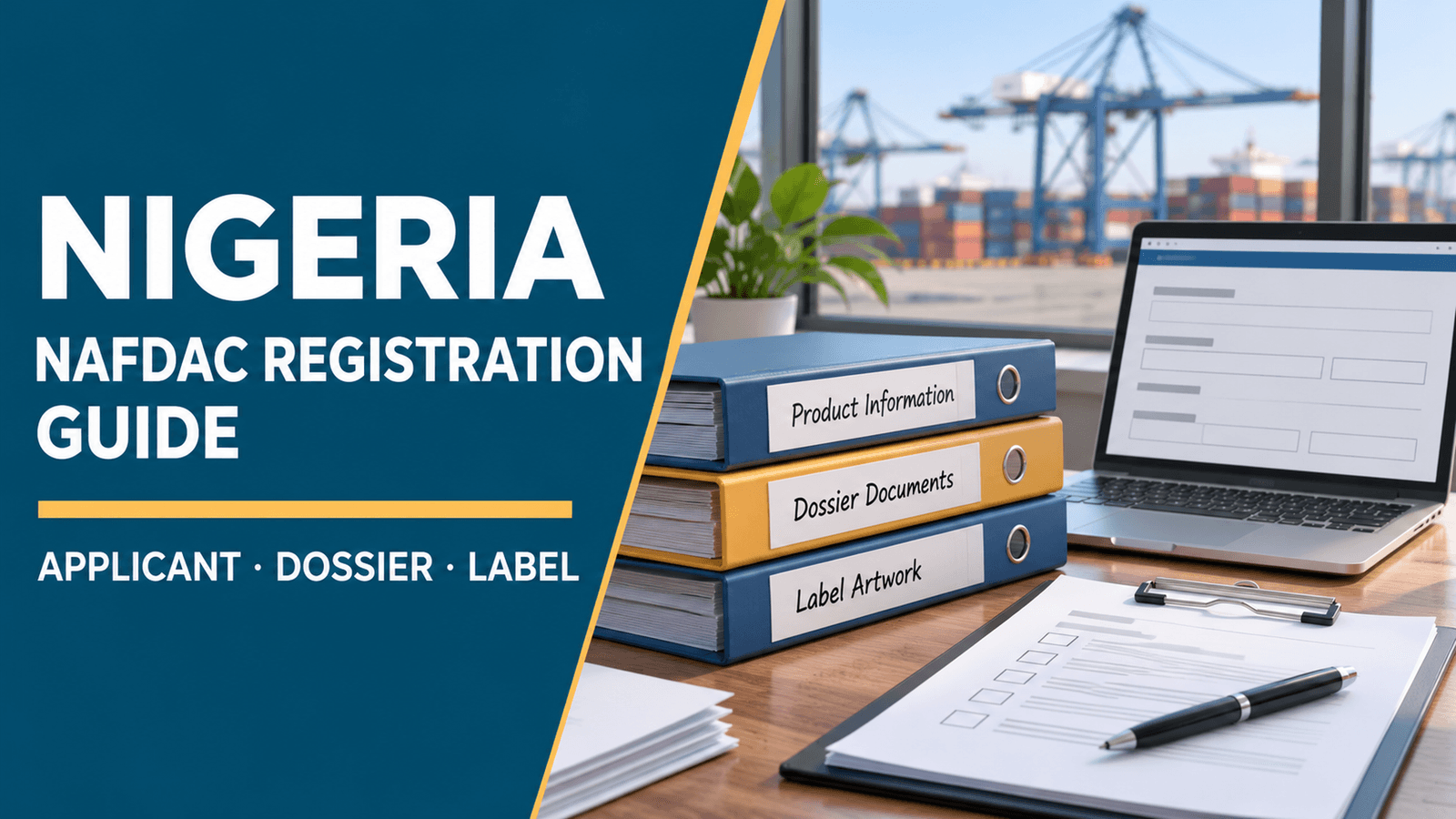
To register a packaged non-alcoholic drink for commercial sale in Nigeria, the responsible applicant must document the importer, overseas manufacturer, brand rights, product specifications and label. NAFDAC's imported-food guidance separates dossier screening, a conditional import permit, label vetting, laboratory review and a registration decision. This guide concerns registration, not customs clearance; Vietnam is an illustrative origin, not a confirmed supplier location.
1. Check scope and ownership before registration
This guide concerns finished, prepackaged non-alcoholic drinks intended for commercial retail distribution within Nigeria. Bulk ingredients, samples, temporary imports and re-export need a separate route assessment. Product formula and packaging determine whether additional food-category rules apply. The NAFDAC imported food guideline, sections 1–2 establishes the imported-food registration context, rather than granting automatic approval to a specific beverage.
The overseas manufacturer prepares accurate manufacturing, quality and labeling evidence. The Nigerian applicant or importer submits the registration dossier and responds to NAFDAC queries. A customs broker coordinates shipment matters separately. An overseas export certificate is not by itself Nigerian marketing authorisation.
2. Confirm applicant authority and the live portal
Sections 2.1–2.4 of the NAFDAC guideline describe an application naming the product and brand and a separate form for each product. Section 3.1.7 requests incorporation evidence for the importing company from Nigeria's Corporate Affairs Commission. Before filing, identify the Nigerian applicant, legal manufacturer, brand owner and intended finished product in writing.
Section 3.1.2 describes a manufacturer's power of attorney for an applicant representing an overseas manufacturer. Section 3.1.4 describes a contract-manufacturing agreement for the relevant brand-owner arrangement. The source specifies signatories, named products and formalisation requirements. These arrangements should not be treated as interchangeable without checking the actual ownership structure.
Portal verification: the guideline refers to an older NAPAMS web address, but the live NAFDAC NAPAMS portal provides account registration, new-product applications, compliance directives and certificate access. The importer should confirm the authorised current filing route directly with NAFDAC before paying or uploading originals.
3. Assemble the product dossier
The following buyer-side dossier matrix summarises sections 3.1.1–3.1.10 of the imported-food guideline. It is a preparation list, not a certificate that a product has met Nigerian requirements.
Evidence | Responsible party | Buyer check |
|---|---|---|
Local incorporation and applicant declaration | Nigerian applicant | Legal name and Nigerian entity match the application |
Power of attorney or contract manufacturing agreement | Manufacturer and brand owner | Named product, brand rights, signatures and applicable notarisation |
Certificate of manufacture and free sale | Overseas manufacturer | Issuer and product/manufacturer names match the proposed drink |
Certificate of analysis | Laboratory and manufacturer | Brand, batch, manufacture/expiry dates and analyst identification |
Trademark and final label artwork | Brand owner | Brand ownership, ingredients and claims align with the actual SKU |
GMP inspection invitation and facility contacts | Manufacturer | Factory address and overseas/local contact details are correct |
The source also describes authentication and notarisation conditions for particular documents. Assign these tasks to the responsible legal entities and confirm today's acceptance requirements with the local applicant before incurring fees. For private label, a change of manufacturer, brand owner, formula or pack art may affect evidence.
4. Separate application, import permit and registration
According to sections 4–7 of the guideline, initial document screening precedes an import permit within the registration process. Label vetting and laboratory samples follow, with review of documentation, manufacturing-site GMP and analytical results before an approval meeting. NAFDAC then issues a registration or listing notification for approved products, or a compliance directive where matters remain unresolved.
The registration-stage import permit is not final retail registration. Section 10.5 says filing or paying does not grant registered status, and section 10.3 treats advertisement permission separately. The NAFDAC ports-inspection guidance index lists a different set of import-clearance workflows. Registration and shipment clearance therefore require independent checks.
5. Buyer decision and stopping points
Before confirming packaging or a purchase order, reconcile the product name, legal manufacturer, brand rights, final formula, certificate of analysis and label artwork. Ask the applicant to identify the current NAFDAC route, any outstanding requests and whether the required supporting originals are ready. Do not assume a specific tariff, turnaround, HS code, or clearance deadline without the actual case and current authority instructions.
If applicant authority, document authentication, category classification or registration status cannot be substantiated, keep the launch plan conditional rather than promising Nigerian shelf readiness.
Sourcing next step: For an OEM/private-label beverage discussion with VINUT TRUST, share Nigeria as the destination, product category or draft formula, pack format and estimated order volume. These facts support importer-led planning, not NAFDAC approval.
QUESTIONS & ANSWERS
Frequently asked questions
May a distributor register unlimited new drinks using one manufacturer authorisation?
Not by assumption. The imported-food guideline links the power of attorney to named products and brand rights. Confirm its scope before adding a separate SKU.
Who checks a change in overseas manufacturer identity?
The Nigerian applicant should reconcile the new company details with manufacturer authority documents, quality records and artwork, then ask NAFDAC whether a variation or new filing is necessary.
Can drinks be sold after a registration-stage import permit is issued?
No such entitlement follows from the imported-food guideline. Confirm the eventual product registration decision and the separate consignment-clearance process.
How can the applicant review a compliance directive or certificate?
NAFDAC's live NAPAMS portal explains how authorised users review submitted applications, compliance directives and the Certificate/Approval area. Actual status must be checked in the account.
Ghana FDA Registration of Imported Prepackaged Drinks
A buyer-facing guide to Ghana FDA importer and product registration: applicant roles, documentary evidence, labels, variants and the difference from import permits.
Read Story
Saudi Food Product Registration for Imported Drinks: Ghad Guide
Ghad registration and clearance checklist for Saudi beverage importers.
Read Story
Dubai Food Item Registration and Label Assessment for Beverages
A Dubai importer checklist for food-item registration and label assessment, including SKU dossiers, Montaji+ and ZAD questions, and pre-shipment controls.
Read Story